
In concrete noise barriers (LSW) with a monolithically bonded facing layer made of lightweight concrete with aggregate voids (LAC) and a structurally dense reinforced concrete core, various forms of damage were observed, ranging from cracking, surface weathering, and spalling within the LAC facing to localized bond failure with partial detachment and falling of the facing.
The objective of the research project was the systematic analysis of these damage causes and damage development mechanisms, taking into account structural, hygrometric, thermal, and material-technological influencing factors. To this end, representative LSW structures were evaluated through structural diagnostics, and material-technological investigations were conducted on the microstructure, water absorption, water retention, and frost-deicing salt resistance of the LAC.
Based on the findings from this damage cause analysis, concrete structural, operational, and material-technological measures were ultimately derived to reliably ensure the durability and quality-assured construction of concrete LSW with an LAC facing.
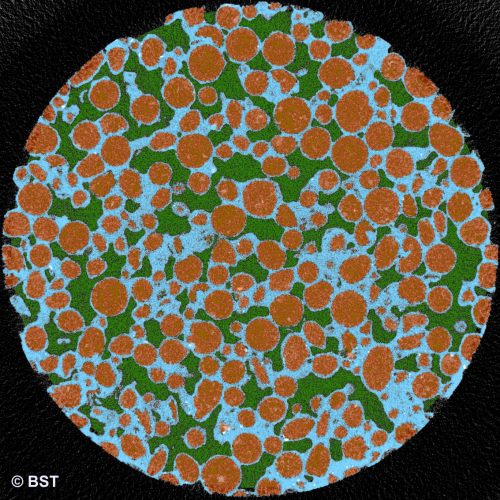
The figure illustrates the segmentation of an LAC sample that was scanned at high resolution using micro-computed tomography (Micro-CT) to precisely visualize and quantitatively evaluate the spatial distribution of the aggregate pores.
Copyright © baustoffe 2026
Last update: May 19, 2026
